
Website Repository
The following is an archive of all of our work, speaking engagements, events, media appearances, and recommended resources.
Tag
- Beijing
- Biden Administration
- Biotech
- Business Insights
- China
- Chinese Surveillance
- Critical Infrastructure
- Cybersecurity
- Disinformation
- Economics
- Elections
- Espionage
- Europe
- Export
- Financial Times
- Governance
- Healthcare
- History
- IP Theft
- In the media
- Industrial Espionage
- Intellectual Property
- Intellectual property
- Intelligence
- Investing
- Iran
- Japan
- Media
- Minerals
- Mining
- NATO
- National Security Laws
- Policy
- Putin
- Russia
- Sanctions
- Satellite
- Secret Trade
- Semiconductors
- Social Media
- Space
- State-sponsored techniques
- Taiwan
- Tech
- Trade
- Trump
- Ukraine
- Xi Jinping
- china
- decoupling

Can democracies defend themselves against Chinese high-tech colonialism?
2430 Group Director, Glenn Chafetz, writes in in a September 9, 2026 article inTomorrow’s Affairs about how the Chinese Communist Party uses global dependence on its high-tech manufacturing and infrastructure as a deliberate geopolitical strategy.

Cornucopia of Vectors of Theft: How China Is Stealing America's Economic Future
In this podcast, 2430 Group Director Glenn Chafetz argues that American companies are losing IP to China because their focus on quarterly profits prevents them from calculating the significant long-term cost of stolen technology and making needed investments in counterintelligence efforts that would protect their IP.
He closes with advice for companies: You have to become sufficiently expert in economic espionage, counter-espionage, counterintelligence, because if you don't, your competitors will.

How can the US protect its health infrastructure against Russian and Chinese cyberattacks?
The US health care system suffers attacks from the governments of Russia and China and their proxies. US hospitals, insurance companies, and physicians experience disruptions via cyber intrusions, control of medical supply chains, and data theft, as well as less directly via infiltration of other infrastructure upon which medical care depends, including telecom, energy, transportation, and power.
Health care accounts for almost a fifth of US GDP, and yet neither the US government nor the healthcare establishment has a coherent strategy for defending the various components of this critical sector. For more on this issue, see the August 3, 2026 article by 2430 Group Director, Glenn Chafetz in Tomorrow’s Affairs.

The US-European Digital Divorce
When policy makers on both sides of the Atlantic discuss transatlantic interdependence, they usually point to military and diplomatic arrangements, liquefied natural gas (LNG) shipments, and semiconductor supply chains. The degree to which Europe runs its entire digital economy on American infrastructure receives far less attention. It deserves more. Europe’s digital foundation is almost entirely American. This includes cloud compute, enterprise networking, cybersecurity, collaboration platforms, and data and storage. Seventy percent of the Europe cloud market is controlled by three US companies: Google, Microsoft, and Amazon. This division of labor has benefitted all the participants, providing efficiencies, reducing costs, and allowing interoperability. The Europeans, however, are now taking steps to end it.
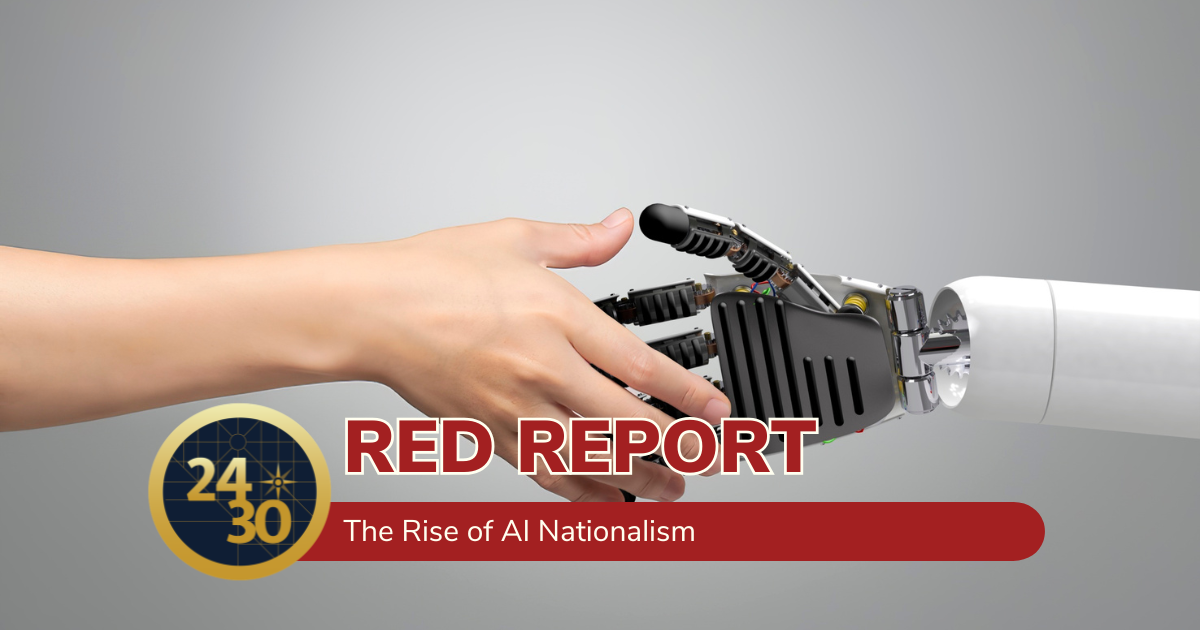
The Rise of AI Nationalism
This week in The Red Report:
Why is the CCP obsessed with “China-Shedding”?
Is AI accelerating economic nationalism?
The Prelude to US-China Negotiations
Do androids dream of electric Xi?
How Chinese satellites support US adversaries
Threat Status: How China's IP theft machine really works
2430 Group Co-Founder Tom Lyons talks to the The Washington Times’ Threat Status podcast about the People's Republic of China's ongoing campaign of intellectual property theft. During the episode, Lyons explained how the PRC uses a sophisticated blend of coercion, fraud, and state-sponsored economic espionage to acquire American innovation. These activities directly undermine US economic stability and national security by eroding technological competitiveness and threatening American jobs. Lyons emphasized that small businesses, the primary engines of US innovation, are frequently targeted and remain uniquely vulnerable to these predatory practices.

Tom Lyons Testifies for the Senate Judiciary Committee
2430 Group Co-Founder Tom Lyons testified on April 22, 2026, before the Senate Judiciary Committee in a hearing titled, “Stealth Stealing: China’s Ongoing Theft of U.S. Innovation.” The People’s Republic of China acquires US technology and other intellectual property via coercion, fraud, and espionage. This state-sponsored activity damages the US economy and national security, costing jobs and economic and technological competitiveness. Small businesses, which drive a significant share of US innovation, remain especially vulnerable to the PRC's attacks. 2430 Group equips these firms with the tools to identify risks and protect their technologies in an increasingly contested global environment.


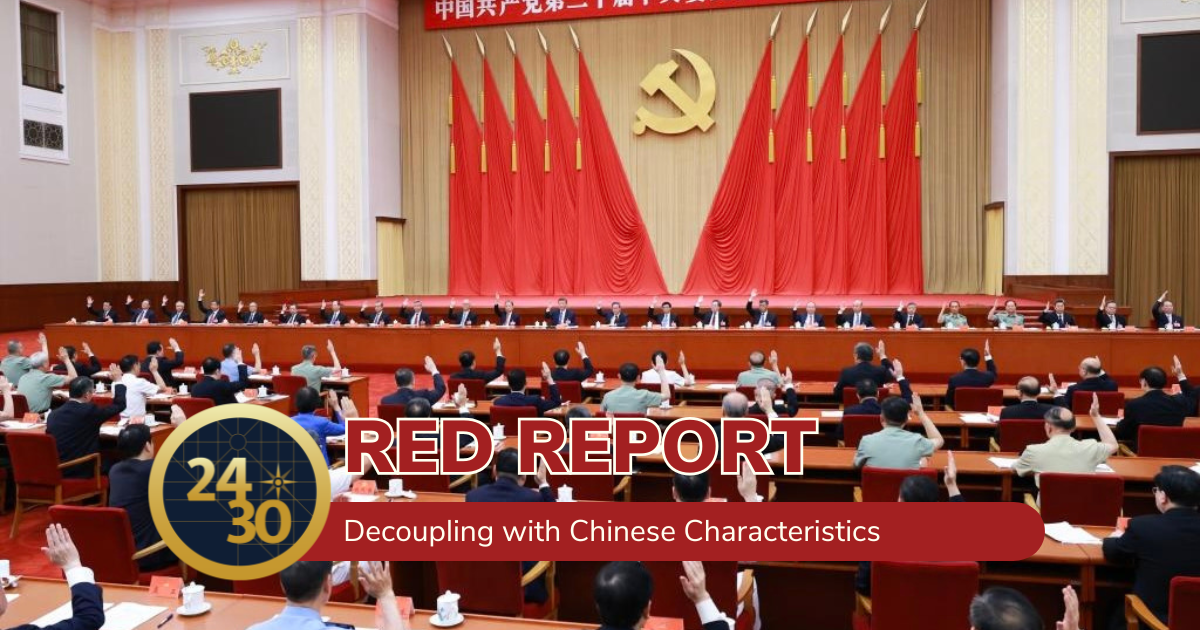
Decoupling with Chinese Characteristics
This week in The Red Report:
Talent wars
China risk is more than compliance risk
How are US tariffs helping Chinese exports?
Why are Chinese tech companies rushing to IPOs?
What does Anthropic’s Mythos mean for China?
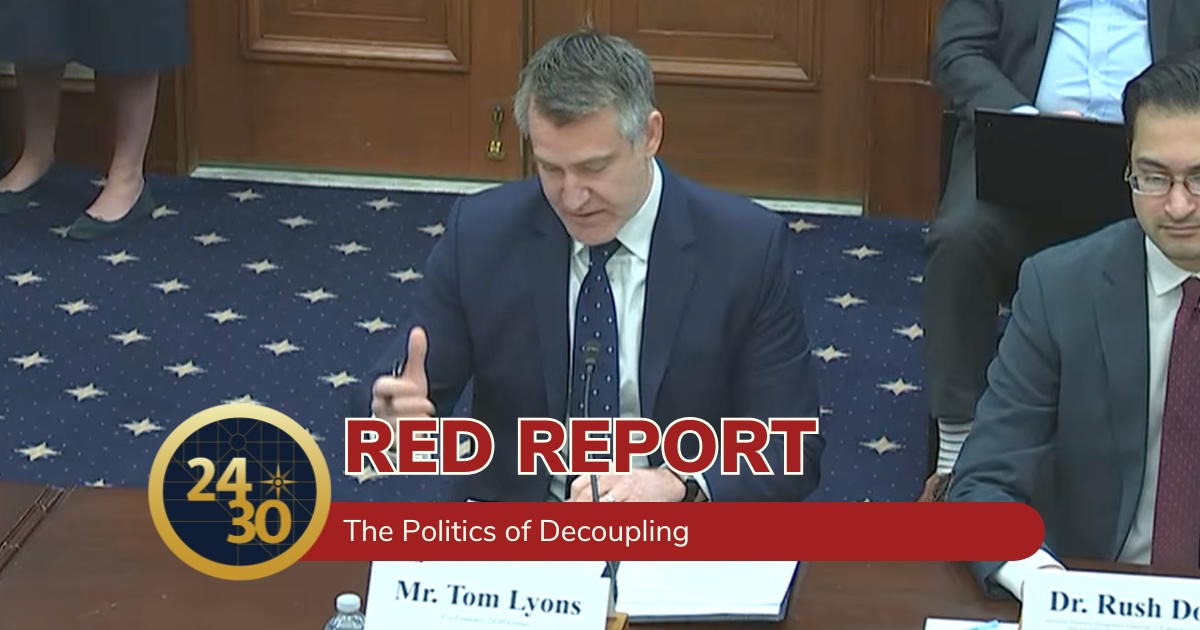
The Politics of Decoupling
This week in The Red Report:
China’s Lobster Problem
Defending Main Street
The Long Slide toward Decoupling
The Geopolitics of Science
IP theft and the threat of denaturalization
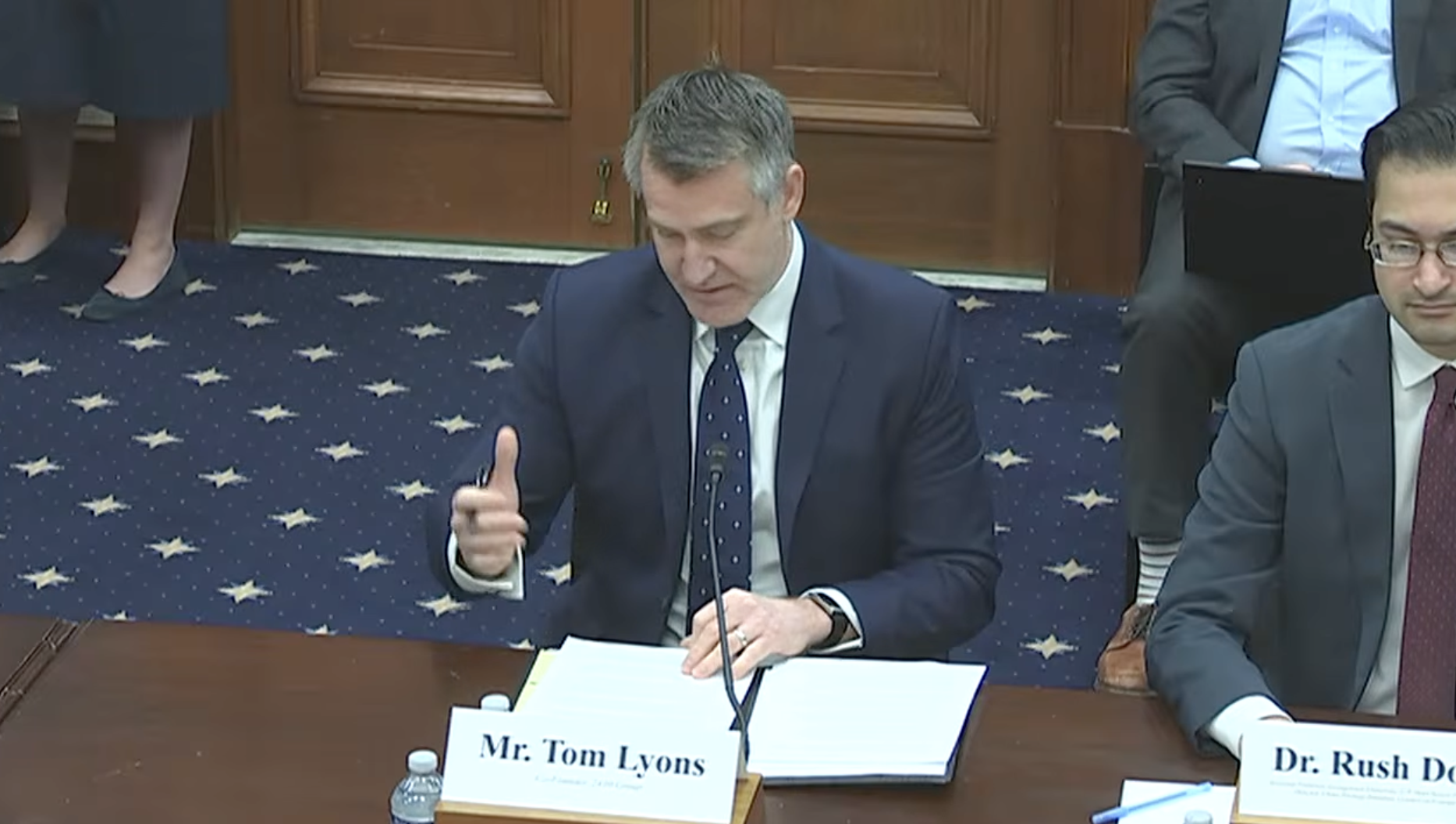
Tom Lyons Testifies for the House Committee on Small Business
2430 Group Co-Founder Tom Lyons testified on March 25, 2026 before the House Committee on Small Business in a hearing on Chinese Communist Party (CCP) threats to Main Street. The People’s Republic of China’s program of economic coercion and intellectual property theft costs US companies trillions of dollars in lost revenue every year. Small businesses constitute the overwhelming majority of innovation in the United States and thus bear the disproportionate burden of China’s attacks. 2430 Group equips those firms to defend themselves.

How is China planning for the future?
This week in The Red Report:
What does the new Five-Year Plan tell us about China’s future?
How is war in Iran changing US-China relations?
Uncertainty awaits: shipping skepticism and new tariffs
What does a crackdown on “Singapore washing” mean for US tech?
The Rise of Autonomous Espionage Infrastructure

No matter your business, your business is geopolitics
This week in The Red Report:
Why Iran matters to China
How to plan for the unplannable
China predicts a “new world order” amid reports of economic malaise
China Builds AI Reach Even as Limits Remain
Is the United States getting wise to corporate espionage?

IDF swerves away from Chinese cars, driven by worries of spies lurking in everyday tech
2430 Group is mentioned in a an article by The Times of Israel about the risks of importing Chinese vehicles on November 26, 2025.

China, Hong Kong, and Russia’s Intelligence and Counter-Espionage Laws
This document is a categorized reference list of the major laws, regulations, and frameworks that shape the People’s Republic of China (PRC), Hong Kong, and Russia’s contemporary national-security and counter-espionage environment.
RedNote: A Threat Assessment
RedNote, a short-form video and augmented reality platform better known in Mandarin as xiaohongshu, or “little red book,” has rapidly gained traction in recent years as an alternative to the video blogging service TikTok, especially among younger users drawn to its immersive alternate reality features and tailored content feeds. Like TikTok, RedNote offers algorithmically driven entertainment; however, its underlying infrastructure and legal obligations differ in critical ways. While TikTok has faced scrutiny over its Chinese parent company, ByteDance, and its opaque data practices, RedNote is even more closely aligned with the People’s Republic of China’s (PRC) surveillance architecture. Promoted as a creative social app, RedNote conforms to PRC policy of surveillance-by-design, requiring extensive data extraction, non-transparent content moderation, and legally mandated state access to user information. This closer look examines how RedNote operates within—and extends—the global reach of China’s digital governance model.
The author, Christian Ryan, is an open-source national security researcher and a Research Fellow at Trefoil Strategies Ltd., a Pittsburgh-based risk consultancy.
